Your AI agent is probably 99% right. In Legal, Finance, Insurance, and Investing, that's the problem.
We build dispatchers,
verified at every step,
with nothing improvised.
AI agents that execute exactly the workflow they're configured for, verified against systems of record. Not smarter. Bounded.
Pedigree & Engineering Provenance
Built by engineers who've done this at scale
"When we say we guarantee the outcome, it's not a marketing line. It's coming from people who've built and shipped this kind of system at the companies above."
The failure isn't inaccuracy.
It's improvisation.
Most AI agent failures don't come from the model being wrong in some deep sense. They come from two specific things:
The Agent Infers & Acts
The agent infers something and acts on the inference as if it were fact, taking actions outside its domain knowledge.
Unverified Task Completion
The agent reports a task complete when nothing actually verified that against the true system of record.
In a consumer chatbot, that's a bad session. In a claim, a filing, a trade, or a compliance check, it's a real loss. And it's exactly the kind of loss that doesn't show up until an audit, a complaint, or a regulator finds it first.
"Unconstrained AI agents completed fewer tasks and took unsafe actions."
This isn't a hunch. A 2026 architecture study found that giving an AI agent more unconstrained access, with more available actions and fewer validation checks, didn't improve its performance.
The unconstrained version completed fewer tasks and took unsafe actions the bounded version didn't. More freedom produced more failure, not more capability. That's independent evidence, not our marketing.
The model proposes.
The system decides.
Every dispatcher we build works the same way, regardless of the workflow:
State-driven
The agent acts on your actual system of record, never on its memory of a conversation.
State = SystemOfRecord.getCurrentState()Typed, bounded commands
The agent chooses only from a fixed set of pre-approved operations for the state it's in. Never an open-ended instruction.
AllowedActions = StateSchema.getTransitions(currentState)This is the actual mechanism behind the guarantee. Because every action the agent can take is a typed, pre-defined operation, there's no space left for it to invent an action nobody approved, which is what makes "the workflow executes exactly as configured" a structural fact, not a hope.
Explicit authority
What's even possible changes with where the process stands. An agent can flag; it can't approve. It can draft; it can't file.
Authority.verifyPermission(agentRole, requestedAction)Verified completion
A task counts as done only once the system of record confirms it. Not because the agent said so.
Task.markComplete() AFTER RecordDb.confirmWritten()The AI-Native Control: Maker-Checker
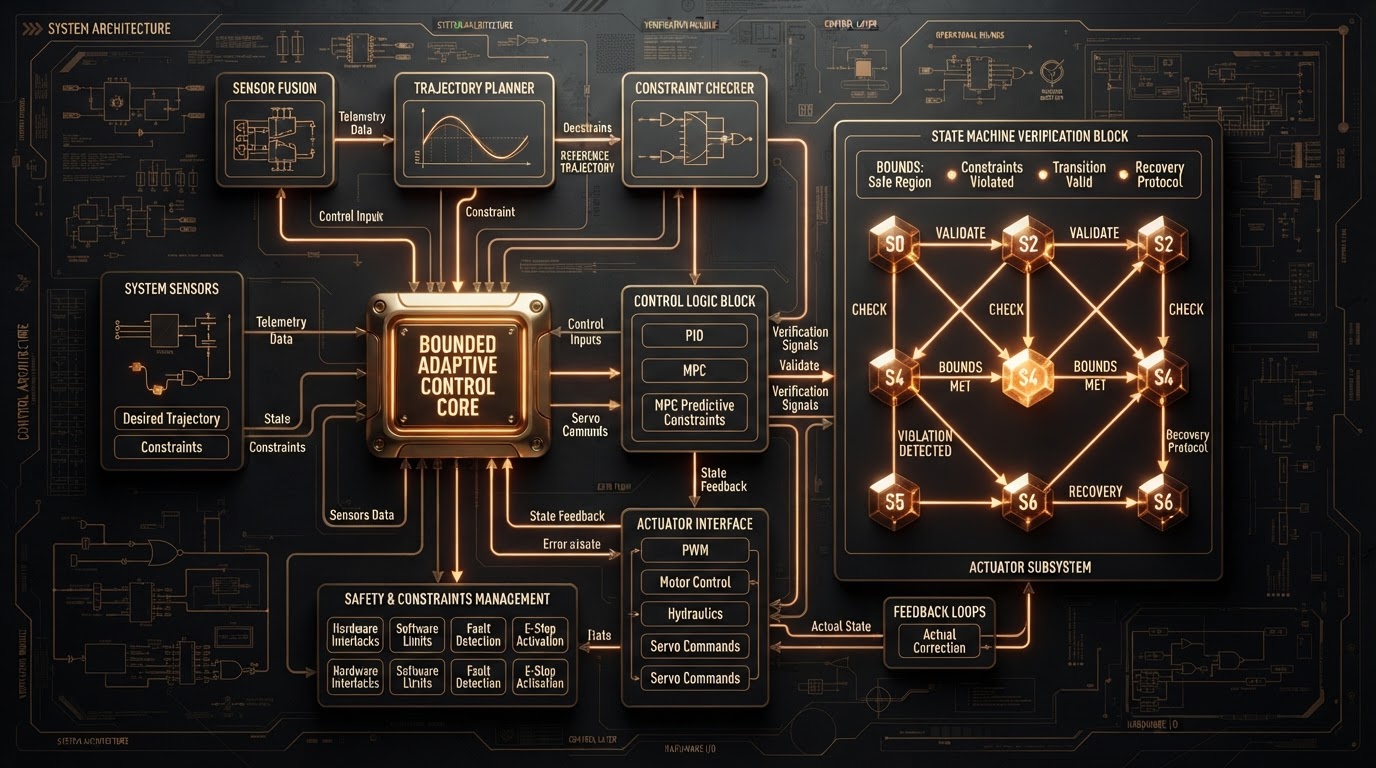
This is the AI-native version of a control your team already trusts: maker-checker. The model is the maker. The system is the checker. Neither is trusted to do the other's job.
This doesn't ship and go quiet.
The dispatcher only ever executes the exact workflow we configure: nothing improvised, nothing invented. That's what's guaranteed: fixed, verifiable, and it doesn't drift.
What isn't fixed is the workflow itself. Every action leaves a trace. We audit it, evaluate it against what actually happened, and adjust the configuration as your business, your regulations, or your process change.
That's why this is a partnership. The guarantee covers what we built; staying on is what keeps it matched to a business that keeps changing.
Built for the workflows where
errors compound.
High-consequence domains where a single unverified step or hallucinated action creates unacceptable liability.
Risk & Compliance
An audit trail built for an examiner, not a dashboard.
Legal & General Counsel
An agent that drafts and flags, structurally incapable of filing or signing without a human step.
Claims & Insurance Ops
Review and escalation that never quietly closes a case it shouldn't have.
Investment Ops
Analysis and flagging with a hard, enforced line between propose and execute.
Questions, answered plainly.
The honest version of every question we get asked, including the ones most vendors avoid.
Not a fixed menu price. Cost is a function of the scope and volume of the specific workflow involved. The relationship starts as one of three types: a scoped engagement to resolve a specific architecture question, a build engagement to put one production dispatcher live, or an ongoing partnership across multiple workflows. Real numbers come after the actual problem is understood, not before.
A general-purpose model answers using its own judgment about what's reasonable in the moment. This architecture removes that judgment call: the model can only select from a fixed, pre-approved set of typed actions valid for exactly where a case or task stands right now. Not a smarter model, a model with no room to improvise.
Sierra pioneered outcome-based pricing for customer-service agents and is expanding toward regulated, outcomes-based work through a platform called Horizon, but as of that expansion it's reported to still lack a document pipeline, policy engine, or regulated-decision audit trail. Different core business (customer support), different maturity in this specific territory.
The closest architectural match in the market, with the same emphasis on policy-driven, evidence-linked decisions. The real difference is business model: that's a self-serve platform a client configures and runs themselves, roughly a 60-day deployment. This is a partnership where the architecture is built together and stays supported as it needs to change.
Independent comparisons describe most large platforms as only "partial" on regulated-decision audit trails, strong on general infrastructure, but still needing custom architecture layered on top to produce a defensible audit trail for one specific regulated decision. Often this kind of engagement sits on top of what's already there rather than replacing it.
Those move data between systems and automate repetitive steps. There's no concept of "which actions are even allowed right now" and no outcome guarantee attached to what they do. Different category of problem, not a cheaper version of the same one.
The realistic alternative, building this kind of bounded system yourself on top of an open framework like LangChain, typically takes 12 to 18 months with a dedicated team, estimated at 5 to 8 engineers, before it's production-ready for a regulated decision. That's what's being displaced, not what an engagement looks like.
Honestly: no completed public case study of the practice's own yet. What exists is the team's direct background building AI-driven systems inside a regulated financial company, plus category-level proof, with other companies using a similar bounded-execution approach in lending, insurance, and legal work, with real published numbers.
Every action the agent can take is a typed, pre-defined operation, not freeform text the system has to interpret. Because there's no path for the model to invent an action nobody approved, the system executing exactly the configured workflow is a structural fact, not a hope. That execution is what's guaranteed. The workflow itself is expected to change over time as regulation or the business changes.
Background rests on real, specific experience: leading AI-driven engineering teams at a major financial-risk-analytics firm (Moody's Analytics), consulting engagements including Spotify for Artists and McKinsey through ThoughtWorks, building a VR product from zero at Nokia, and current consulting work with OpenAI on coding-focused model training.
Execution of the current configuration is guaranteed; the configuration itself is expected to change as regulation, products, or the business change. That's exactly why this is structured as an ongoing partnership rather than a one-time delivery.
Yes, SOC 2 compliant. This is a hardcore, credentialed team, not a question to hedge on.
The pitch isn't "trust us broadly." It's that the architecture makes trust unnecessary for the specific claim being made: the system's completions are independently verified, not self-reported by the AI, so a mistake is caught structurally rather than relying on anyone's vigilance to notice it.
Because completion is verified independently of what the AI reports, and its authority is limited to actions valid for its exact current state, a mistake either can't happen (the action wasn't available to attempt) or gets caught immediately (the verification step catches it), rather than surfacing later as an unnoticed error.
From first call to build, in four steps.
Alignment call
After connecting, the first conversation is a Zoom call to confirm both sides are actually a good fit before going further. This is the qualifying step: understanding the real problem, whether it fits this kind of engagement, and whether it's worth continuing.
Technical call with the lead engineer
A second Zoom call brings in the lead engineer directly, so the prospect can go deeper technically and close any knowledge gaps left from the first call. The first call qualifies the fit, the second call handles the architecture and technical depth.
The strategy phase
$5,000Once both calls confirm a fit, the engagement moves into a paid strategy phase. A dev dispatcher gathers everything needed about the prospect's actual workflow, systems, and constraints to build the strategy.
The strategy delivered
The completed strategy covers the full project detail, including an estimated timeline to complete the build. A dedicated manager is assigned once the strategy is delivered and the build moves forward.
A partner, not a vendor.
We take on a small number of engagements, including architecture mandates, build programs, and embedded partnerships, with teams where the result actually matters and the boundary is still unresolved.
Architecture Mandates
Rigorous evaluation of state transitions and safety boundary design.
Custom Dispatchers
Bespoke development of state-driven, typed execution agents.
Embedded Partner
Continuous evaluation, audit trail analysis, and workflow tuning.
This isn't commodity implementation or staff augmentation. If you're running a process where a small error rate is a real cost, not a rounding error, that's the conversation we want.